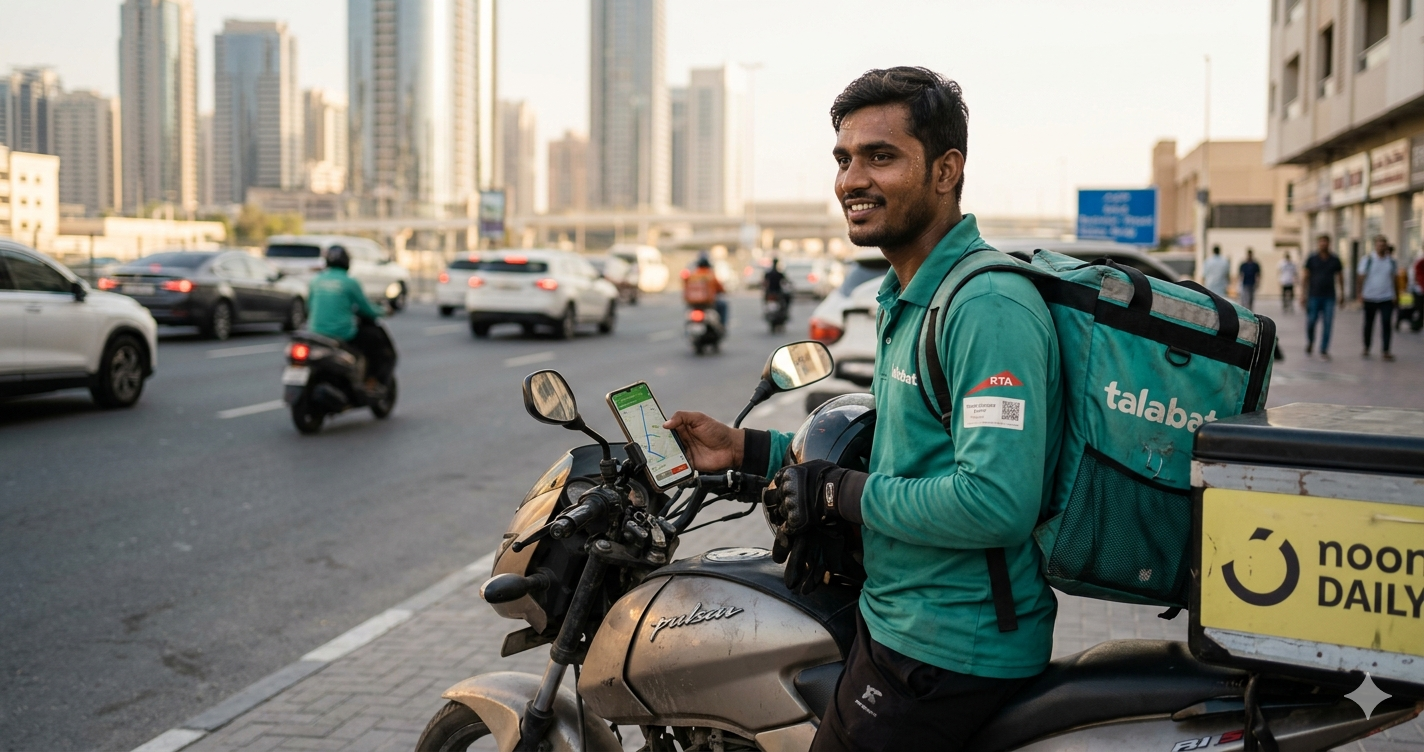
Are you planning to join the thousands of riders weaving through Dubai’s busy streets? The dream of earning in Dirhams attracts many, but the reality of Delivery Rider Jobs in Dubai (Talabat & Noon) is a mix of high-speed hustle and strict regulations. Whether you are looking for a fresh start or a side hustle, knowing the “honest truth” before you land at DXB is crucial.
This guide breaks down the earnings, the visa process, and the hidden costs that most recruitment agents won’t tell you. We will compare the two giants—Talabat and Noon—to help you decide which platform fits your goals for 2026.
What is the Dubai Delivery Gig and Why it Matters
The food delivery sector in Dubai is more than just a service; it is the backbone of the city’s fast-paced lifestyle. With extreme summer temperatures and a culture of convenience, residents rely on apps like Talabat and Noon Food for everything from morning coffee to midnight snacks.
For a rider, this matters because “order volume” is the only thing that dictates your income. Dubai offers a unique landscape where high population density meets world-class infrastructure, allowing efficient riders to complete more trips per hour than in almost any other global city. However, the market is competitive. Understanding the nuances of these platforms helps you navigate a system where your performance—and your knowledge of the city’s “dark stores” and shortcuts—directly impacts your take-home pay.
Step-by-Step Guide: How to Start as a Rider in Dubai
Starting your journey as a delivery rider requires a legal framework. You cannot simply download the app and start driving. Follow these steps to get on the road:
-
Secure a Residency Visa: You must have a valid UAE residence visa. Most riders work under a “Delivery Service” company that sponsors their visa, though some use a Freelance Visa or their own family sponsorship with an NOC.
-
Obtain a UAE Motorcycle License: If you have a license from your home country, you still need to undergo training at an RTA-approved school (like Emirates Driving Institute or Belhasa). This process involves eye tests, theory classes, and a final road test.
-
Register with a 3PL (Third Party Logistics): Talabat and Noon rarely hire riders directly. You will likely sign a contract with a logistics partner who provides the bike, the SIM card, and the medical insurance.
-
Complete the RTA Delivery Permit: To deliver food specifically, you need an additional “RTA Food Delivery Permit,” which costs approximately 1,000 AED per year and requires a brief training session on food safety.
-
The Onboarding Kit: Once approved, you’ll receive your kit—a thermal bag, branded vest, and the app credentials.
The Math/Formula Behind Your Earnings
Your income is not a fixed salary; it is a calculated result of your efficiency. In 2026, the standard earning formula for a rider in Dubai looks like this:
Where:
-
$N$ (Number of Orders): The average rider completes 15–25 orders per day.
-
$D$ (Delivery Fee): Talabat typically pays 7.50 AED per order. Noon Food varies, often ranging from 8.50 AED to 12 AED depending on distance and zones.
-
$I$ (Incentives): Weekly bonuses for completing “streaks” (e.g., +200 AED for 100 orders in a week).
-
$T$ (Tips): Riders usually keep 100% of digital and cash tips.
-
$C$ (Costs): If you are on a commission model, you must subtract fuel (approx. 500–700 AED/month) and bike maintenance.
On average, a hardworking rider earns between 3,500 AED and 5,500 AED per month before expenses.
Real-Life Scenarios: What Can You Actually Save?
Scenario 1: The “New Joiner” on Talabat
Ahmed works 10 hours a day, 26 days a month. He averages 18 deliveries a day at 7.50 AED.
-
Gross Pay: 3,510 AED.
-
Tips/Incentives: 500 AED.
-
Expenses (Fuel + Room + Food): 1,800 AED.
-
Net Savings: 2,210 AED.
Scenario 2: The “Veteran” on Noon Food
Raj knows the shortcuts in Dubai Marina. He works 12 hours during peak shifts and completes 25 orders a day at an average of 9 AED.
-
Gross Pay: 5,850 AED.
-
Tips/Incentives: 800 AED.
-
Expenses: 2,000 AED.
-
Net Savings: 4,650 AED.
FAQs about Dubai Delivery Jobs
1. Can I work on a visit visa?
Absolutely not. Working on a visit visa is illegal in the UAE and can lead to heavy fines, deportation, and a lifetime ban. You must have a proper employment or freelance visa.
2. Who pays for the bike and fuel?
It depends on your contract. In a “Fixed Salary” model, the company usually provides the bike and fuel. In a “Commission” model, you often rent the bike from the company and pay for your own petrol.
3. Is Talabat better than Noon?
Talabat has a higher volume of orders (less waiting time), but Noon often pays a slightly higher rate per delivery. Most experienced riders prefer Talabat for its “Drop Density,” meaning you spend less time driving to the next customer.
Conclusion & CTA
Being a delivery rider in Dubai is a test of endurance, but for those who are disciplined, it remains one of the most accessible ways to earn a stable income in the UAE. The key is to avoid “hidden fee” agents and ensure you are working with a reputable logistics partner.
Ready to start your journey? If you have your UAE license ready, check the official Talabat Rider or Noon Food portals today to find their authorized partners and get on the road!
Would you like me to help you draft a professional CV specifically for Dubai delivery companies?
Related Posts: